what did prince henry do to improve sea travel
| Prince Henry the Navigator | |
|---|---|
| Duke of Viseu | |
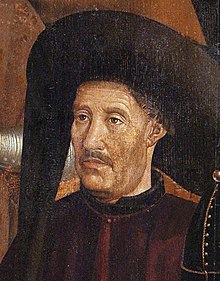 Infante Dom Henrique; St. Vincent Panels[a] | |
| Born | iv March 1394 Porto, Portugal |
| Died | thirteen November 1460(1460-xi-13) (aged 66) Sagres, Portugal |
| Burial | Batalha Monastery |
| House | Aviz |
| Male parent | John I of Portugal |
| Mother | Philippa of Lancaster |
| Faith | Roman Catholicism |
Dom Henrique of Portugal, Knuckles of Viseu (iv March 1394 – 13 November 1460), better known as Prince Henry the Navigator (Portuguese: Infante Dom Henrique, o Navegador), was a central figure in the early days of the Portuguese Empire and in the 15th-century European maritime discoveries and maritime expansion. Through his authoritative management, he is regarded as the principal initiator of what would be known as the Age of Discovery. Henry was the fourth kid of the Portuguese King John I, who founded the House of Aviz.[1]
Later procuring the new caravel ship, Henry was responsible for the early on development of Portuguese exploration and maritime trade with other continents through the systematic exploration of Western Africa, the islands of the Atlantic Bounding main, and the search for new routes. He encouraged his father to conquer Ceuta (1415), the Muslim port on the North African coast across the Straits of Gibraltar from the Iberian Peninsula. He learned of the opportunities offered by the Saharan trade routes that terminated at that place, and became fascinated with Africa in general; he was almost intrigued by the Christian legend of Prester John and the expansion of Portuguese trade. He is regarded as the patron of Portuguese exploration.
Life [edit]

Frontispiece of Zurara'southward Crónicas dos Feitos de Guiné (Paris codex), with the phrase talent de Bien Faire ("the talent of doing well" or "Hunger for adept deeds") and the pyramids, of Prince Henry'southward motto. It has been argued that the image inserted portrays his brother, Rex Duarte, rather than Henry. The Empresa or divisa placed beneath is Henry's motto. According to Friar Luis de Sousa, based on papers of Henry's contemporary chronicler Gomes Eanes de Zurara, and other 15th-century documents, Henry'south pyramids represented the pyramids of Egypt, at Giza, and at the meridian of his pyramids was a gold sunday.
Henry was the tertiary surviving son of King John I and his married woman Philippa,[ii] sister of King Henry 4 of England. He was baptized in Porto, and may have been built-in at that place, probably when the purple couple was living in the city's sometime mint, now called Casa exercise Infante (Prince's House), or in the region nearby. Another possibility is that he was born at the Monastery of Leça exercise Balio, in Leça da Palmeira, during the same period of the royal couple's residence in the city of Porto.[3]
Henry was 21 when he and his father and brothers captured the Moorish port of Ceuta in northern Morocco. Ceuta had long been a base for Barbary pirates who raided the Portuguese coast, depopulating villages by capturing their inhabitants to be sold in the African slave trade. Following this success, Henry began to explore the coast of Africa, most of which was unknown to Europeans. His objectives included finding the source of the Westward African golden merchandise and the legendary Christian kingdom of Prester John, and stopping the pirate attacks on the Portuguese coast.
At that time, the cargo ships of the Mediterranean were too tiresome and heavy to undertake such voyages. Under Henry'due south management, a new and much lighter transport was developed, the caravel, which could sail further and faster.[4] Above all, information technology was highly maneuverable and could sail "into the air current", making it largely independent of the prevailing winds. The caravel used the lateen sail, the prevailing rig in Christian Mediterranean navigation since late antiquity.[five] With this ship, Portuguese mariners freely explored uncharted waters around the Atlantic, from rivers and shallow waters to transocean voyages.[6]
In 1419, Henry'southward father appointed him governor of the province of the Algarve.
Resources and income [edit]
On 25 May 1420, Henry gained appointment as the Grand Main of the Armed forces Order of Christ, the Portuguese successor to the Knights Templar, which had its headquarters at Tomar in central Portugal.[7] Henry held this position for the remainder of his life, and the Social club was an important source of funds for Henry's ambitious plans, especially his persistent attempts to conquer the Canary Islands, which the Portuguese had claimed to have discovered before the twelvemonth 1346.
In 1425, his second brother the Infante Peter, Duke of Coimbra, made a diplomatic bout of Europe, with an additional charge from Henry to seek out geographic material. Peter returned with a current earth map from Venice.[8]
In 1431, Henry donated houses for the Estudo Geral to teach all the sciences—grammar, logic, rhetoric, arithmetics, music, and astronomy—in what would after become the University of Lisbon. For other subjects like medicine or philosophy, he ordered that each room should be decorated according to the subject taught.
Henry too had other resource. When John I died in 1433, Henry's eldest brother Edward of Portugal became king. He granted Henry all profits from trading within the areas he discovered as well as the sole correct to qualify expeditions beyond Greatcoat Bojador. Henry also held a monopoly on tuna fishing in the Algarve. When Edward died 8 years later, Henry supported his blood brother Peter, Duke of Coimbra for the regency during the minority of Edward's son Afonso V, and in return received a confirmation of this levy.
Henry functioned as a primary organizer of the disastrous expedition to Tangier in 1437 against Çala Ben Çala, which ended in Henry's younger brother Ferdinand beingness given as hostage to guarantee Portuguese promises in the peace agreement. The Portuguese Cortes refused to return Ceuta as ransom for Ferdinand, who remained in captivity until his decease half dozen years later. Prince Regent Peter supported Portuguese maritime expansion in the Atlantic Ocean and Africa, and Henry promoted the colonization of the Azores during Peter'due south regency (1439–1448). For nigh of the latter part of his life, Henry concentrated on his maritime activities and court politics.[9]
Vila do Infante and Portuguese exploration [edit]

According to João de Barros, in Algarve, Prince Henry the Navigator repopulated a village that he called Terçanabal (from terça nabal or tercena nabal).[10] This village was situated in a strategic position for his maritime enterprises and was later chosen Vila exercise Infante ("Estate or Town of the Prince").
It is traditionally suggested that Henry gathered at his villa on the Sagres peninsula a schoolhouse of navigators and map-makers. However modern historians hold this to be a misconception. He did employ some cartographers to chart the coast of Mauritania afterwards the voyages he sent there, but there was no middle of navigation scientific discipline or observatory in the modernistic sense of the give-and-take, nor was there an organized navigational center.[11]
Referring to Sagres, sixteenth-century Portuguese mathematician and cosmographer Pedro Nunes remarked, "from it our sailors went out well taught and provided with instruments and rules which all map makers and navigators should know."[12]
The view that Henry'south court speedily grew into the technological base for exploration, with a naval arsenal and an observatory, etc., although repeated in popular culture, has never been established.[13] [14] [15] Henry did possess geographical marvel, and employed cartographers. Jehuda Cresques, a noted cartographer, has been said to take accepted an invitation to come up to Portugal to brand maps for the infante. Prestage makes the argument that the presence of the latter at the Prince'south court "probably accounts for the legend of the School of Sagres, which is now discredited."[seven]
The kickoff contacts with the African slave market were made by expeditions to ransom Portuguese subjects enslaved by pirate attacks on Portuguese ships or villages.
Henry's explorations [edit]

Henry sponsored voyages, collecting a 20% tax (o quinto) on profits, the usual practice in the Iberian states at the time. The nearby port of Lagos provided a convenient habitation port for these expeditions. The voyages were made in very small ships, mostly the caravel, a light and maneuverable vessel equipped past lateen sails. Most of the voyages sent out by Henry consisted of one or 2 ships that navigated by following the declension, stopping at night to tie up forth some shore.
During Prince Henry'south fourth dimension and after, the Portuguese navigators discovered and perfected the Due north Atlantic volta do mar (the 'plow of the bounding main' or 'return from the sea'): the dependable design of trade winds blowing largely from the east nearly the equator and the returning westerlies in the mid-Atlantic. This was a major step in the history of navigation, when an understanding of oceanic wind patterns was crucial to Atlantic navigation, from Africa and the open ocean to Europe, and enabled the principal route betwixt the New Globe and Europe in the North Atlantic in futurity voyages of discovery. Although the lateen sail immune sailing upwind to some extent, information technology was worth even major extensions of course to have a faster and calmer following wind for most of a journey. Portuguese mariners who sailed s and southwest towards the Canary Islands and Westward Africa would afterwards sail far to the northwest—that is, away from continental Portugal, and seemingly in the wrong direction—before turning northeast near the Azores islands and finally east to Europe in gild to accept largely post-obit winds for their full journeying. Christopher Columbus used this on his transatlantic voyages.
Madeira [edit]
The outset explorations followed not long after the capture of Ceuta in 1415. Henry was interested in locating the source of the caravans that brought gold to the city. During the reign of his begetter, John I, João Gonçalves Zarco and Tristão Vaz Teixeira were sent to explore forth the African declension. Zarco, a knight in service to Prince Henry, had commanded the caravels guarding the coast of Algarve from the incursions of the Moors. He had besides been at Ceuta.
In 1418, Zarco and Teixeira were blown off-grade by a storm while making the volta do mar westward swing to return to Portugal. They institute shelter at an isle they named Porto Santo. Henry directed that Porto Santo exist colonized. The motility to claim the Madeiran islands was probably a response to Castile'southward efforts to claim the Canary Islands.[16] In 1420, settlers so moved to the nearby island of Madeira.
The Azores [edit]
A chart drawn past the Catalan cartographer, Gabriel de Vallseca of Mallorca, has been interpreted to signal that the Azores were first discovered by Diogo de Silves in 1427. In 1431, Gonçalo Velho was dispatched with orders to determine the location of "islands" first identified by de Silves. Velho apparently got as far every bit the Formigas, in the eastern archipelago, before having to render to Sagres, probably due to bad weather.
By this time the Portuguese navigators had also reached the Sargasso Bounding main (western North Atlantic region), naming it after the Sargassum seaweed growing there (sargaço / sargasso in Portuguese).[17] [18]
West African declension [edit]
Until Henry's time, Cape Bojador remained the nearly southerly point known to Europeans on the desert coast of Africa. Superstitious seafarers held that beyond the cape lay sea monsters and the edge of the earth. In 1434, Gil Eanes, the commander of one of Henry's expeditions, became the first European known to pass Cape Bojador.

Using the new ship type, the expeditions then pushed onwards. Nuno Tristão and Antão Gonçalves reached Cape Blanco in 1441. The Portuguese sighted the Bay of Arguin in 1443 and built an important slave fort on the island of Arguin effectually the year 1448. Dinis Dias shortly came across the Senegal River and rounded the peninsula of Cap-Vert in 1444. By this stage the explorers had passed the southern boundary of the desert, and from so on Henry had one of his wishes fulfilled: the Portuguese had circumvented the Muslim land-based trade routes beyond the western Sahara Desert, and slaves and gold began arriving in Portugal. This rerouting of merchandise devastated Algiers and Tunis, only made Portugal rich.[19] By 1452, the influx of gilt permitted the minting of Portugal's first aureate cruzado coins. A cruzado was equal to 400 reis at the time. From 1444 to 1446, as many every bit forty vessels sailed from Lagos on Henry'southward behalf, and the commencement private mercantile expeditions began.
Alvise Cadamosto explored the Atlantic coast of Africa and discovered several islands of the Cape Verde archipelago between 1455 and 1456. In his first voyage, which started on 22 March 1455, he visited the Madeira Islands and the Canary Islands. On the 2nd voyage, in 1456, Cadamosto became the kickoff European to achieve the Republic of cape verde Islands. António Noli afterwards claimed the credit. By 1462, the Portuguese had explored the coast of Africa as far as nowadays-day Sierra Leone. Twenty-eight years later, Bartolomeu Dias proved that Africa could be circumnavigated when he reached the southern tip of the continent, at present known as the Cape of Good Hope. In 1498, Vasco da Gama became the start European sailor to reach Republic of india by sea.
[edit]
No ane used the nickname "Henry the Navigator" to refer to prince Henry during his lifetime or in the following iii centuries. The term was coined by two nineteenth-century German historians: Heinrich Schaefer and Gustave de Veer. Afterwards it was made popular by two British authors who included it in the titles of their biographies of the prince: Henry Major in 1868 and Raymond Beazley in 1895.[xi] In Portuguese, even in modernistic times, it is uncommon to call him by this epithet; the preferred utilise is "Infante D. Henrique".[ commendation needed ]
Contrary to his brothers, Prince Henry was not praised for his intellectual gifts by his contemporaries. It was but later chroniclers such every bit João de Barros and Damião de Góis who attributed him a scholarly graphic symbol and an interest for cosmography. The myth of the "Sagres school" allegedly founded by Prince Henry was created in the 17th century, mainly by Samuel Purchas and Antoine Prévost. In nineteenth-century Portugal, the idealized vision of Prince Henry as a putative pioneer of exploration and scientific discipline reached its apogee.[xx]
Travels in Brazil, in the Years 1817–1820: Undertaken by Control of His Majesty the King of Bavaria by Dr. J.B. Von Spix and Dr. C.F.P. Von Martius, published 1824, refers to the introduction of sugar cane to Brazil by "the Infant Don Henrique Navegador".
Fiction [edit]
- Arkan Simaan, L'Écuyer d'Henri le Navigateur, Éditions l'Harmattan, Paris. Historical novel based on Zurara'due south chronicles, written in French. ISBN 978-2-296-03687-1
Ancestry [edit]
Encounter likewise [edit]
- Prince Henry the Navigator Park
- Hermitage of Our Lady of Guadalupe
Notes [edit]
- ^ The traditional paradigm of the Prince presented in this folio, and coming from the Saint Vincent Panels, is nevertheless under dispute.
References [edit]
- ^ Ivana Elbl, "Man of His Time (and Peers): A New Look at Henry the Navigator." Luso-Brazilian Review 28.ii (1991): 73-89.
- ^ ""Prince Henry the Navigator", The Mariners' Museum". Archived from the original on 7 Apr 2016. Retrieved 19 May 2015.
- ^ Bradford, 1960.
- ^ Merson, John (1990). The Genius That Was China: E and Westward in the Making of the Modern Earth . Woodstock, New York: The Overlook Press. pp. 72. ISBN978-0-87951-397-9A companion to the PBS Series The Genius That Was Communist china
{{cite book}}: CS1 maint: postscript (link) - ^ Castro et al. 2008, p. 2
- ^ Boorstin, Daniel (1985). The Discoverers: A History of Man's Search to Know His World and Himself. Vintage. pp. 156–64.
- ^ a b Prestage, Edgar. "Prince Henry the Navigator." The Cosmic Encyclopedia Vol. 7. New York: Robert Appleton Company, 1910. 23 May 2015
- ^ "Blitz, Timothy. "Prince Henry the Navigator and the Apollo Project that Launched Columbus", 21st Century, summer, 1992" (PDF).
- ^ Bradford, 1960.
- ^ Bluteau, Rafael (1721). Vocabulario portuguez & latino ... Lisbon: na officina de Pascoal da Sylva. p. 109.
- ^ a b Randles, W.G.L. "The alleged nautical schoolhouse founded in the fifteenth century at Sagres by Prince Henry of Portugal chosen the 'Navigator'". Imago Mundi, vol. 45 (1993), pp. 20–28.
- ^ Mark, Hans. "Henry the Navigator and the Early Days of Exploration", American Association for the Advancement of Scientific discipline, Almanac meeting, February 1992
- ^ Marques, Alfredo Pinheiro (2005). Os Descobrimentos east o 'Atlas Miller' (in Portuguese). Universidade de Coimbra. , p. 52
- ^ Rocha, Daniel (eight February 2009). "Brasil: historiador nega existência da Escola de Sagres". Público . Retrieved xvi October 2013.
- ^ de Albuquerque, Luís (1990). Dúvidas e Certezas na História dos Descobrimentos Portugueses. Lisboa. pp. 15–27.
- ^ Fernandez-Armesto, Felipe. 1492: The Yr Our World Began. ISBN one-4088-0950-eight
- ^ "Archived copy". Archived from the original on 15 December 2013. Retrieved thirteen April 2013.
{{cite web}}: CS1 maint: archived copy as title (link) - ^ "The Sargasso Sea". BBC Nature . Retrieved 6 June 2011.
- ^ Rice Jr., Eugene F.; Grafton, Anthony (1994). The Foundations of Early Modern Europe, 1460-1559. West.Westward. Norton & Visitor. p. 35.
- ^ Alegria, Maria Fernanda; Daveau, Suzanne; Garcia, Joao Carlos; Relaño, Francesc (2007). "Portuguese Cartography in the Renaissance". In Woodward, David (ed.). Cartography in the European Renaissance (PDF). The History of Cartography. Vol. 3. Academy of Chicago Press. p. 1002. ISBN978-0-226-90733-viii.
- ^ a b John I, King of Portugal at the Encyclopædia Britannica
- ^ a b c d e f Armitage-Smith, Sydney (1905). John of Gaunt: King of Castile and Leon, Knuckles of Aquitaine and Lancaster, Earl of Derby, Lincoln, and Leicester, Seneschal of England. Charles Scribner'south Sons. p. 21. Retrieved 17 July 2018.
- ^ a b Peter I, King of Portugal at the Encyclopædia Britannica
- ^ a b de Sousa, Antonio Caetano (1735). Historia genealogica da casa real portugueza [Genealogical History of the Royal House of Portugal] (in Portuguese). Vol. ii. Lisboa Occidental. p. 4.
Sources [edit]
- Ariganello, Lisa. Henry the Navigator : prince of Portuguese exploration (2007); for unproblematic schools. online
- Beazley, C. Raymond (1894). Prince Henry the Navigator, the Hero of Portugal and of Modernistic Discovery, 1394–1460 A.D.: With an Account of Geographical Progress Throughout the Middle Ages As the Preparation for His Work. London: G.P. Putnam's Sons.
- Beazley, Charles Raymond (1911). . In Chisholm, Hugh (ed.). Encyclopædia Britannica. Vol. thirteen (11th ed.). Cambridge Academy Press. pp. 296–297.
- Boxer, Charles (1991). The Portuguese Seaborne Empire, 1415–1825 (2d rev. ed.). Carcanet Press. ISBN978-0-85635-962-0.
- Bradford, Ernle. A current of air from the north; the life of Henry the Navigator (1960) online
- Castro, F.; Fonseca, North.; Vacas, T.; Ciciliot, F. (2008), "A Quantitative Look at Mediterranean Lateen- and Square-Rigged Ships (Part 1)", The International Journal of Nautical Archaeology, vol. 37, no. 2, pp. 347–359, doi:10.1111/j.1095-9270.2008.00183.x, S2CID 45072686
- Diffie, Bailey; George D. Winius (1977). Foundations of the Portuguese empire, 1415–1580. Academy of Minnesota Press. ISBN978-0-8166-0782-ii.
- Elbl, Ivana. "Human of His Time (and Peers): A New Look at Henry the Navigator." Luso-Brazilian Review 28.2 (1991): 73-89. online
- Fernández-Armesto, Felipe (1987). Before Columbus: Exploration and Colonisation from the Mediterranean to the Atlantic, 1229–1492. London: MacMillan Education. ISBN978-0-333-40383-9.
- Major, Richard Henry (1877). The discoveries of Prince Henry, the Navigator, and their results. London: Sampson, Low, Marston, Searle and Rivington. OCLC 84044057.
- Martins, J.P. Oliveira (1914). The golden age of Prince Henry the Navigator. London: Chapman and Hall.
- Russell, Peter E. (2000). Prince Henry "the Navigator": a life. New Haven: Yale University Printing. ISBN978-0-300-08233-3. OCLC 42708239.
- Zurara, Gomes Eanes de, trans. Edgar Prestage (1896). Chronica do Descobrimento e Conquista da Guiné, vol. 1 (The chronicle of discovery and conquest of Guinea). Hakluyt Society.
{{cite book}}: CS1 maint: multiple names: authors list (link) - Zurara, Gomes Eanes de, trans. Edgar Prestage (1896). Chronica do Descobrimento e Conquista da Guiné, vol. 2. Printed for the Hakluyt Society.
{{cite book}}: CS1 maint: multiple names: authors list (link)
Source: https://en.wikipedia.org/wiki/Prince_Henry_the_Navigator#:~:text=After%20procuring%20the%20new%20caravel,the%20search%20for%20new%20routes.
0 Response to "what did prince henry do to improve sea travel"
Post a Comment