How Does the Carpool Lane Know You Have Mutliple People?
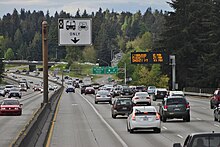
A loftier-occupancy vehicle lane (also known every bit an HOV lane, carpool lane, diamond lane, 2+ lane, and transit lane or T2 or T3 lanes) is a restricted traffic lane reserved for the exclusive use of vehicles with a driver and one or more passengers, including carpools, vanpools, and transit buses. These restrictions may be merely imposed during peak travel times or may apply at all times. According to the criteria used at that place are different types of lanes: temporary or permanent with physical barriers; 2-directional or reversible; and sectional, concurrent or contraflow lanes working in pinnacle periods.[1] The normal minimum occupancy level is two or 3 occupants. Many jurisdictions exempt other vehicles, including motorcycles, charter buses, emergency and law enforcement vehicles, low-emission and other green vehicles, and/or single-occupancy vehicles paying a cost. HOV lanes are ordinarily introduced to increment average vehicle occupancy and persons traveling with the goal of reducing traffic congestion and air pollution,[2] [3] [iv] although their effectiveness is questionable.[5] [half dozen]
Regional and corporate-sponsored vanpools, carpools, and rideshare communities requite commuters a way to increment occupancy. For places without such services, online rideshare communities can serve a like purpose.[ citation needed ] Slugging lines are common in some places, where solo drivers selection up a rider to share the ride and let them to use the HOV lane. High-occupancy toll lanes (HOT lanes), which allow solo driver vehicles to use HOV lanes on payment of a fee which varies depending on demand, take also been introduced in the United States and Canada.
History [edit]
The states [edit]

The first freeway HOV facility opened in 1969 in the Shirley Highway in Northern Virginia. As of 2012 the I-95/I-395 HOV facility operates equally a two-lane bulwark-separated reversible HOV iii+ facility (center lanes) with admission through elevated on- and off-ramps.
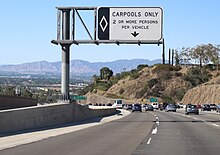
Before 2020, Caltrans traditionally preferred to use the term "carpool" in lieu of "HOV," every bit seen on Interstate 405 in Los Angeles.
The introduction of HOV lanes in the Usa progressed slowly during the 1970s and early 1980s. Major growth occurred from the mid-1980s to the late 1990s.[7] The get-go freeway HOV lane in the United States was implemented in the Henry G. Shirley Memorial Highway in Northern Virginia, betwixt Washington, DC, and the Capital Beltway, and was opened in 1969 as a motorcoach-only lane.[7] [8] [9] The busway was opened in December 1973 to carpools with four or more occupants, becoming the first example in which buses and carpools officially shared a HOV lane over a considerable distance.[10] [11]
In 2005, the 2 lanes of this HOV 3+ facility carried during the morning time peak hour (6:30 am to 9:thirty am) a total of 31,700 people in viii,600 vehicles (3.7 persons/veh), while the three or four general-purpose lanes carried 23,500 people in 21,300 vehicles (1.1 persons/veh). Average travel time in the HOV facility was 29 minutes, and 64 minutes in the general traffic lanes.[12] As of 2012, the I-95/I-395 HOV facility is 30 mi (48 km) long, extends from Washington, D.C., to Dumfries, Virginia, and has two reversible lanes separated from the regular lanes by barriers, with access through elevated on- and off-ramps. Three or more than people in a vehicle (HOV 3+) are required to travel on the facility during rush hours on weekdays.[13]
The 2nd expressway HOV facility was the contraflow bus lane on the Lincoln Tunnel Approach and Helix in Hudson County, New Bailiwick of jersey, opened in 1970.[seven] Co-ordinate to the Federal Highway Assistants (FHWA), the Lincoln Tunnel XBL is the country's HOV facility with the highest number of peak hour persons amongst HOV facilities with utilization data bachelor, with 23,500 persons in the morn peak,[8] and 62,000 passengers during the 4-hour morning peak.[14]
The first permanent HOV facility in California was the featherbed lane at the San Francisco–Oakland Bay Bridge toll plaza, opened to the public in April 1970.[nine] The El Monte Busway (I-ten / San Bernardino State highway) in Los Angeles was initially only available for buses when information technology opened in 1973. Three-person carpools were allowed to use the bus lane for iii months in 1974 due to a strike past bus operators, so permanently at a 3+ HOV from 1976. It is one of the most efficient HOV facilities in North America[15] and is currently being converted into a high-occupancy cost lane operation to allow low-occupancy vehicles to bid for excess chapters on the lane in the Metro ExpressLanes project.[xvi]
Starting time in the 1970s, the Urban Mass Transit Administration recognized the advantages of sectional charabanc lanes and encouraged their funding. In the 1970s the FHWA began to permit state highway agencies to spend federal funds on HOV lanes.[x] As a result of the 1973 Arab Oil Embargo, interest in ridesharing picked up, and states began experimenting with HOV lanes. In order to reduce crude oil consumption, the 1974 Emergency Highway Energy Conservation Human action mandated maximum speed limits of 55 mph (89 km/h) on public highways and became the offset instance when the U.South. federal government provided funding for ridesharing and states were allowed to spend their highway funds on rideshare sit-in projects. The 1978 Surface Transportation Help Human activity fabricated funding for rideshare initiatives permanent.[xi]
Also during the early 1970s, ridesharing was recommended for the outset time equally a tool to mitigate air quality problems. The 1970 Make clean Air Human activity Amendments established the National Ambient Air Quality Standards and gave the Ecology Protection Bureau (EPA) substantial authority to regulate air quality attainment. A final command plan for the Los Angeles Basin was issued in 1973, and one of its chief provisions was a two-phase conversion of 184 mi (296 km) of motorway and arterial roadway lanes to coach/carpool lanes and the evolution of a regional computerized carpool matching system. However, information technology took until 1985 before any HOV project was constructed in Los Angeles County, and by 1993 there were only 58 mi (93 km) of HOV lanes countywide.[11]
A significant policy shift took place in October 1990, when a memorandum from the FHWA administrator stated that "FHWA strongly supports the objective of HOV preferential facilities and encourages the proper application of HOV technology." Regional administrators were directed to promote HOV lanes and related facilities.[10] Besides in the early 1990s, two laws reinforced the U.Southward. commitment to HOV lane construction. The Clean Air Act Amendments of 1990 included HOV lanes as one of the transportation control measures that could be included in land implementation plans to attain federal air quality standards. The 1990 amendments also deny the administrator of the EPA the authority to cake FHWA from funding 24-60 minutes HOV lanes equally part of the sanctions for a state's failure to comply with the Clean Air Human action, if the secretary of transportation wishes to approve the FHWA funds.[10]
On the other hand, the Intermodal Surface Transportation Efficiency Act (ISTEA) of 1991 encouraged the structure of HOV lanes, which were made eligible for Congestion Mitigation and Air Quality (CMAQ) funds in regions non attaining federal air quality standards. CMAQ funds may be spent on new HOV lane construction, even if the HOV designation holds only at summit travel times or in the tiptop management. ISTEA likewise provided that under the Interstate Maintenance Program, only HOV projects would receive the 90% federal matching ratio formerly available for the addition of general purpose lanes. ISTEA, in addition, permitted state authorities to define a high occupancy vehicle as having a minimum of 2 occupants (HOV 2+).[10]
Every bit of 2009, California was the country with the most HOV facilities in the country, with 88, followed by Minnesota with 83 facilities, Washington with 41, Texas with 35, and Virginia with 21. By 2006, HOV lanes in California were operating at two-thirds of their chapters, and these HOV facilities carried on average ii,518 persons per hr during peak hours, substantially more than people than the congested general-traffic lanes.[2]
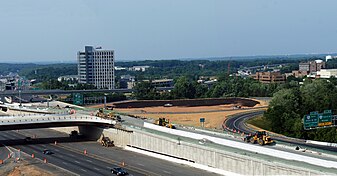
Equally of October 2016, the longest continuous HOV facility in the U.South. is on I-fifteen in Utah, extending approximately 72.0 mi (115.9 km) from Layton to Spanish Fork with a unmarried HOV lane in each direction for a total of 144.0 mi (231.7 km) of HOV lanes.[17] While the Utah facility is the longest, the I-495 Majuscule Beltway in the Washington, D.C., Metropolitan Area extends 56.0 mi (90.one km) but has two HOV lanes in each direction for a total of 224.0 mi (360.5 km) of HOV lanes.[8]
Every bit of 2012, there are some 126 HOV facilities on freeways in 27 metropolitan areas in the United States, which includes over i,000 corridor miles (ane,600 km).[xviii]
Canada [edit]
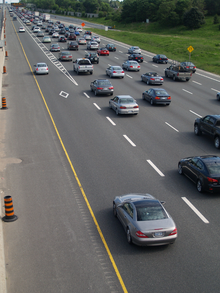
The beginning HOV facilities in Canada were opened in Greater Vancouver and Toronto in the early on 1990s, followed shortly by facilities in Ottawa, Gatineau, Montreal, and later Calgary. As of 2010 there were virtually 150 km (93 mi) of highway HOV lanes in 11 locations in British Columbia, Ontario, and Quebec, and over 130 km (81 mi) of arterial HOV lanes in 24 locations in Greater Vancouver, Calgary, Toronto, Ottawa, and Gatineau.[2] The Ontario Ministry of Transportation (MTO) in 2006 estimated that commuters in Toronto using the HOV facilities on Highways 403 and 404 were saving xiv–17 minutes per trip compared to their travel time earlier the HOV lanes opened. The MTO also estimated that virtually 40% of commuters were carpooling on Highway 403 eastbound in the morning time peak hour, compared to 14% in 2003, and 37% of commuters were carpooling on Highway 403 westbound in the afternoon peak hour, compared to 22% in 2003. The boilerplate rush 60 minutes speed on the HOV lanes is 100 km/h (62 mph), compared to 60 km/h (37 mph) in general-traffic lanes on Highway 403.[2] Temporary HOV lanes were added to selections of 400-serial highways in the Greater Toronto Area for the 2015 Pan American Games and 2015 Parapan American Games.
Europe [edit]
Every bit of 2012, there are a few HOV lanes in operation in Europe. The primary reason for this is that, in full general, European cities have amend public transport services and fewer loftier-capacity multi-lane urban motorways than do the U.Due south. and Canada. However, at around 1.3 persons per vehicle, average car occupancy is relatively depression in most European cities.[19] The accent in Europe has been on providing bus lanes and on-street omnibus priority measures.[20]
The start HOV lane in Europe was opened in holland in October 1993 and operated until August 1994. Its facility was a seven km (4.3 mi) barrier-separated HOV iii+ on the A1 nigh Amsterdam. The facility did not attract enough users to overcome public criticism and was converted to a reversible lane open to full general traffic after the guess in a legal examination case ruled that Dutch traffic law lacked the concept of a car pool and thus that the principle of equality was violated.[twenty] [21]
Spain was the adjacent European land to introduce HOV lanes, when median reversible HOV lanes were opened in Madrid's A-6 in 1995. This facility is Europe's oldest HOV facility that is nevertheless in operation.[xx]
The showtime HOV facility in the United Kingdom opened in Leeds in 1998. The facility was implemented on A647 road virtually Leeds as an experimental scheme, but it became permanent. The HOV facility is 1.five km (0.93 mi) long and operates every bit a HOV ii+ facility.[19] [20] [22]
A two.8 km (one.7 mi) HOV 3+ facility opened in Linz, Republic of austria, in 1999.
The offset HOV lane in Norway was implemented in May 2001 as an HOV 3+ on Elgeseter Street, an undivided four-lane arterial road in Trondheim. This facility was followed by HOV lanes in Oslo and Kristiansand.[xx] [23]
New Zealand and Australia [edit]
The first HOV lane (known as a Transit Lane T2 or T3[24]) in Australia opened in February 1992, located on the Eastern Pike in Melbourne travelling inbound.[25] In May 2005, T2 Transit lanes were opened on Hoddle Street in Melbourne.[26] As of 2012, there were besides T2 and T3 facilities in Canberra, Sydney and Brisbane.
In Auckland, New Zealand, at that place are several short HOV 2+ and 3+ lanes throughout the region, commonly known as T2 and T3 lanes.[27] There is a T2 transit lane in Tamaki Drive, in a short stretch between Okahu Bay Reserve and downtown Auckland.[28] In that location are besides T2 priority lanes on Auckland'south Northern, Southern, Northwestern, and Southwestern Motorways. These priority lanes are left-side on-ramp lanes heading towards the motorway, where vehicles with two or more people can bypass the ramp meter signal. Priority lanes can also be used by trucks, buses, and motorcycles, and the priority lanes tin be used by carpoolers at whatever fourth dimension.[28] Eleven lanes were opened to electric vehicles in a one-twelvemonth trial from September 2017.[29] In that location are also several short T2 and T3 facilities in N Shore Metropolis operating during rush hours.[xxx]
Indonesia [edit]
In Jakarta, HOV 3+ is known every bit "3 in One" (Tiga dalam satu) and was start implemented by governor Sutiyoso. HOV 3+ is implemented on weekdays in existing roads of Sisingamangaraja Road (fast and slow lane), Jalan Jenderal Sudirman (fast and tedious lane), Jalan Grand.H. Thamrin (fast and ho-hum lane), Medan Merdeka Barat Road, Majapahit Road, and sections of Jalan Jenderal Gatot Subroto. The policy was originally implemented merely betwixt 7:00 am and ten:00 am. Since the introduction of Jakarta's bus rapid transit in December 2003, the policy was extended to 7:00 am – 10:00 am and 4:00 pm – 7:00 pm. In September 2004, the evening time was changed to 4:30 pm – 7:00 pm.[ citation needed ] Machine jockeys are paid by drivers to ride on vehicles, so that those vehicles would bypass the 3 in one restriction.[31] [32] On August thirty, 2016, an odd–even rationing (ganjil-genap) organisation began to replace "3-in-1" dominion, after a successful trial. Odd plate numbers tin can enter former "3-in-ane" areas on odd days and even plate numbers on even ones.[33]
China [edit]
In Shenzhen, HOV two+ has been implemented on Binhai Artery since 25 April 2016. The policy was and then extended to 7:30 am – nine:30 am and 5:30 pm – 9:30 pm.
In Chengdu, from January 23, 2017, HOV 2+ has been implemented on Kehua Road South, Kehua Road Middle, and Tianfu Avenue Department 1 and two, during 7:00 am-9: 00 am and 5:00 pm-seven: 00 pm.
In Dalian, an expressway (Northeast Expressway, or Dongbei Superhighway) linking old town and new boondocks had one lane in both outbound and inbound directions set to HOV 2+. Starting from September 20, 2017, commuters tin can opt to drive in HOV lane on Northeast Throughway during the morning superlative hours of 06:30-08:30, and evening elevation hours of 16:xxx-19:00. A fine of CNY100 (most USD15) volition be enforced for first violators. For a second violation, the fine will double.
Pattern and operations [edit]

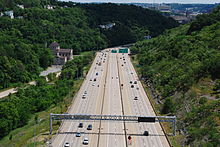
An HOV lane on I-24 in Nashville, Tennessee. These lanes role every bit HOV lanes only on weekdays during blitz 60 minutes, and every bit regular lanes the residue of the time.
HOV lanes may be either a unmarried traffic lane within the main roadway with distinctive markings or a divide roadway with one or more than traffic lanes either parallel to the general lanes or grade-separated, above or beneath the full general lanes. For example, Interstate 110 in California has four HOV lanes on an upper deck.
HOV featherbed lanes to allow carpool traffic and police force to bypass areas of regular congestion in many places and an HOV lane may operate every bit a reversible lane, working in the management of the dominant traffic menstruation in both the morning and the afternoon. All lanes of a 10 miles (16 km) section of the Interstate 66 in the suburbs of Washington, D.C., are treated as an HOV during the rush hr in the master direction of period.[13]
The traffic speed differential between HOV and full general-purpose lanes creates a potentially unsafe situation if the HOV lanes are not separated by a barrier. A Texas Transportation Plant written report found that HOV lanes lacking bulwark separations caused a 50% increase in injury crashes.[34]
Variants [edit]
Business concern admission and transit lane [edit]
A concern admission and transit (BAT) lane is a blazon of HOV lane that allows for all traffic to enter the lane for a short distance in order to access other streets and business entrances.[35]
Loftier-occupancy toll lane [edit]
Because some HOV lanes were not utilized to their full capacity, users of depression- or unmarried-occupancy vehicles may be permitted to use an HOV lane if they pay a toll. This scheme is known as high-occupancy cost lane (or HOT lanes), and it has been introduced mainly in the United States. The beginning practical implementation was California'due south formerly private cost 91 Limited Lanes, in Orange County, California, in 1995, followed in 1996 by Interstate xv north of San Diego.[36] [37] According to the Texas A&M Transportation Institute, by 2012 there were 294 corridor-miles of HOT/Limited lanes and 163 corridor-miles of HOT/Limited lanes nether construction in the United States.[38]

FasTrak RFID station in Orange County, California
Solo drivers are permitted to use the HOV lanes upon payment of a fee that varies based on demand. Tolls modify throughout the twenty-four hour period according to real-time traffic conditions, which is intended to manage the number of cars in the lanes to maintain good journey times.[39] [40]
Proponents merits that all motorists benefit from HOT lanes, even those who choose not to use them. This statement applies only to projects that increment the total number of lanes.[41] Proponents also claim that HOT lanes provide an incentive to use transit and ridesharing.[ commendation needed ] There has been controversy over this concept, and HOT schemes have been chosen "Lexus" lanes, as critics see this new pricing scheme as a perk for the rich.[42]
HOT tolls are nerveless by manned toll booths, automatic number plate recognition, or electronic toll drove systems. Some systems use RFID transmitters to monitor entry and exiting of the lane and accuse drivers depending on need. Typically, tolls increase equally traffic density and congestion within the tolled lanes increment, a policy known as congestion pricing. The goal of this pricing scheme is to minimize traffic congestion within the lanes.[43] [44]
Qualifying vehicles [edit]

A slugging area, where solo drivers observe a passenger to use the HOV
Qualification for HOV condition varies by scheme, but the post-obit vehicles may be included:
- Individual cars and taxis with a minimum number of human occupants (ofttimes two or 3), including babies of whatsoever age (but only after birth)[45]
- Single-occupant dark-green vehicles, such as hybrid electrical vehicles, plug-in hybrids, and battery electric vehicles[46] [47]
- Motorcycles[48] - motorcycles are allowed via federal United states of america HOV lane police force (Championship 23, Section 166).[49] They cannot utilize HOV lanes in Ontario unless they have 2 passengers.[50]
- Buses designed to send sixteen or more than passengers, including the driver[45]
- Public utility vehicles when responding to emergency calls[45]
- Bicycles[48]
- Police are allowed to use the HOV lanes in Ontario.[51]
New York City HOV lane codes prior to 2008 did non let motorcycles leading to ticketing of motorbike drivers and complaints from the American Motorcyclist Association, but have since been revised to comply with the federal regulations listed to a higher place.[49] [52] [53]
In some jurisdictions such as Ontario, Canada, taxicabs and airport limousines are immune to use HOV lanes even when no passenger is nowadays because that vehicle "will be able return to duty faster after dropping off a fare or arrive sooner to pick up a fare, thereby moving more people to their destinations in fewer vehicles".[50]
In Virginia, the San Francisco Bay Area, Houston, and other HOV lane locations, commuters form sluglines where drivers pick upwards i or more passengers from a designated "coincidental carpool" or "slug lines" to bulldoze on HOV lanes; the driver pulls over near the sluglines and shouts out their destination, and people in the line going to that destination enter the motorcar on a showtime-come, first-served footing.[54]
Compliance, enforcement, and avoidance [edit]
Fines are unremarkably imposed on drivers of not-qualifying vehicles who use the lanes.[55]
Following the introduction of HOVs, some drivers placed inflatable dolls in the passenger seat, a do that persists today, even though it is now illegal.[55] Cameras that tin can distinguish between humans and mannequins or dolls were tested in the United kingdom in 2005.[56]
In the The states, police force enforcement officials have documented a variety of methods used by drivers in attempts to circumvent HOV occupancy rules:
- Placing store mannequins, blow-up dolls, kickboxing dummies, or paper-thin cut-outs in the passenger seat;
- Taping styrofoam wig stands with wigs or balloons with faces drawn on them to the passenger seat headrest;
- Buckling the passenger-side seat belt and pretending to talk to someone reclining in that seat;
- Tinting the forepart windshield and/or lowering the passenger side visor in an attempt to obstruct the view into the rider seat;
- Covering an empty infant seat with a coating and/or placing a doll in it;
- Strapping dogs, cats, or other pets into the passenger seat.[57]
In early 2006, an Arizona woman asserted that she had been improperly ticketed for using the HOV lane because the unborn kid she was conveying in her womb justified her use of the lane, while noting that Arizona traffic laws do not define what constitutes a person. Nevertheless, a approximate subsequently ruled that to qualify every bit an "private" nether Arizona traffic laws, the individual must occupy a "split and distinct" space in a vehicle.[57] Besides, in California, in gild to apply HOV lanes, at that place must be two (or, if posted, three) separate individuals occupying seats in a vehicle, and an unborn child does not count towards this requirement.[58]
In 2009 and 2010 it was found that non-compliance rates on HOV lanes in Brisbane, Commonwealth of australia, were budgeted xc%. Enhanced enforcement led to increased compliance, boilerplate jitney journey times dropped by nearly nineteen%, and total person throughput increased past 12%.[59]
In February 2010, a 61-year-old woman tried to laissez passer off a life-sized mannequin equally a passenger in order to utilise the HOV lane in New York Land. A police force officeholder on a routine HOV patrol became suspicious when he noticed that the so-called passenger was wearing sunglasses and using the visor on a cloudy morning. When the officer approached the vehicle, he discovered that the "rider" was, in fact, a mannequin wearing lipstick, designer shades, a total-length wig, and a blue sweater. The driver was issued a traffic ticket for using the HOV lane without a human being passenger, which carries a fine of $135 in 2010 and 2 points on a driver's license.[sixty] [61]
In January 2013, a motorist tried to claim that the Articles of Incorporation of his business, which had been placed unbuckled on the passenger's seat, constituted a person, citing the principle of corporate personhood and California's state Vehicle Code, which defines a person every bit "natural persons and corporations". This argument was rejected in traffic court, where the presiding judge commented, "Common sense says conveying a sheaf of papers in the front seat does not salvage traffic congestion."[62]
In March 2015, a motorist tried to utilize a paper-thin cutout of thespian Jonathan Goldsmith to access an HOV lane in Fife, Washington. The officer noted that other drivers had used sleeping bags in before attempts to access the HOV lane.[63]
Effectiveness [edit]
According to 2009 data from the U.Southward. demography, 76% drive to work lonely and only x% rideshare. For suburban commuters working in a city, the solo driving rate is 82%.[64]
Some underused HOV lanes in several states have been converted to high-occupancy toll lanes (HOT), which offer solo drivers access to HOV lanes later on paying a price.[64]
HOV lanes are too an effective style to manage traffic subsequently natural disasters, equally seen in New York Metropolis after Hurricane Sandy in Oct 2012. At the time Mayor Bloomberg banned passenger cars with fewer than iii occupants from entering Manhattan. The restriction affected all bridges and tunnels entering the city except the George Washington Span.[65]
Criticism [edit]
Critics have argued that HOV lanes are underused. It is unclear whether HOV lanes are sufficiently used to compensate for delays in the other mixed-utilise lanes.[66] [67]
The situations have acquired social problems in Republic of indonesia, where some people become "car jockey", people who make their living past offering drivers to make full their automobile in order to meet the occupancy limit. Reportedly, the situation caused people stay in unemployment for doing so, increased congestion and let parents profit from their babies.[68] [69] [70] [71] [33] [72] [73]
Gallery [edit]
-
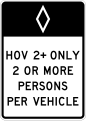
Standard restrictive traffic sign in the United states of america. The diamond symbol (◊) indicates a preferential-only lane restriction, in this case an HOV with two or more occupants
-

California's red Make clean Air Vehicle sticker to permit solo admission for electric cars to HOV lanes.
-

California's green Clean Air Vehicle sticker used to allow solo admission for plug-in hybrids to HOV lanes.
See also [edit]
- Jitney rapid transit
- Shell load – Loftier rider vehicle occupancy leading to burdensome
- Headway – Altitude between vehicles in a transit organization measured in time or space
- Local-express lanes
- Passengers per hr per direction – Measure of passenger chapters of a transportation network
- Platoon (motorcar) – Group of vehicles travelling separately but following another
- Road capacity – Vehicles or people on a given route in a given time
- Price road
- Transportation Need Management
Notes and references [edit]
- ^ Caves, R. W. (2004). Encyclopedia of the City. Routledge. p. 339.
- ^ a b c d "Loftier Occupancy Vehicle Lanes in Canada – Overview". Ship Canada. 2010-08-26. Archived from the original on 2012-04-xix.
- ^ Federal Highway Administration (2009-07-27). "A Review of HOV Lane Functioning and Policy Options in the United states – Section 1: Introduction". FHWA Tolling and Pricing Programme. Retrieved 2012-04-25 .
- ^ "Transit Lanes". Roads & Traffic Authority, NSW. Retrieved 2012-04-25 . Budapest 29–31 Oct 2003.
- ^ Yair Wiseman (November 2019). "Loftier Occupancy Vehicle Lanes are an Expected Failure" (PDF). International Journal of Command and Automation.
- ^ Sharon Shewmake (November 2012). "Can Carpooling Clear the Route and Clean the Air? Evidence on the Impact of HOV Lanes on VMT and air pollution". Journal of Planning Literature. 27 (4): 363–374. doi:10.1177/0885412212451028. S2CID 154610953.
- ^ a b c Katherine F. Turnbull. "History of HOV Facilities". Federal Highway Administration (FHWA). Retrieved 2012-04-26 . Complete business relationship published in Katherine F. Turnbull (1992), "HOV Project Case Studies: History and Institutional Arrangements"
- ^ a b c Federal Highway Administration (December 2008). "Section 2: Operational Description of the Nation'southward HOV Lanes". FHWA Tolling and Pricing Program. Retrieved 2012-04-24 .
- ^ a b California Department of Transportation (Caltrans) (2007). "Managed Lane". Caltrans. Retrieved 2012-04-26 .
- ^ a b c d e Christopher K. Leman; Preston L. Schiller; Kristin Pauly. "Re-Thinking HOV – High Occupancy Vehicle Facilities and the Public Interest". National Transportation Library. Archived from the original on 2010-12-04. Retrieved 2012-04-30 . Research funded partly by the Chesapeake Bay Foundation and the Bullitt Foundation, pp. 3–v.
- ^ a b c MIT "Real-Time" Rideshare Enquiry (2009-01-24). "Selective History of Ridesharing – The 1970s Energy Crises". Massachusetts Plant of Technology. Retrieved 2012-04-thirty .
- ^ Peter Samuel (2005-01-12). "HOV lanes clogged with hybrids-complicate toll programme". Toll Roads News. Archived from the original on 2012-09-12. Retrieved 2012-04-25 .
- ^ a b "High Occupancy Vehicle (HOV) Systems". Virginia Section of Transportation (VDOT). 4 Dec 2017.
- ^ American Public Transit Association (APTA). "Public Transportation: Moving America Frontward" (PDF). APTA. Archived from the original (PDF) on 2013-01-02. Retrieved 2012-04-25 . Run into p. 6
- ^ Texas Transportation Found (September 2002). "Executive Study. Furnishings of Irresolute HOV Lane occupancy requirements: El Monte Busway Example Study". Federal Highway Assistants. Archived from the original on 2017-06-17. Retrieved 2012-04-27 .
- ^ "Metro Express Lanes".
- ^ "UDOT and UHP launch Express Lane education and enforcement rush – Transportation Blog". blog.udot.utah.gov. Archived from the original on 2017-12-27. Retrieved 2017-12-31 .
- ^ Freeway Management Plan, FHWA (2012-01-12). "Oft Asked HOV Questions". Federal Highway Assistants. Retrieved 2012-02-27 .
- ^ a b Quinn DJ, Gilson DR, Dixon MT (1998). "U.k.'due south first high occupancy vehicle lane – the A647, Leeds". ETC Proceedings. Archived from the original on 2012-10-xvi. Retrieved 2012-04-27 .
- ^ a b c d due east Due south. Schijns (2006). "Loftier Occupancy Vehicle Lanes – Worldwide Lessons for European Practitioners" (PDF). McCormick Rankin Corp. Archived from the original (PDF) on 2010-06-thirteen. Retrieved 2012-04-25 . See Section 3.1
- ^ "Dutch parliamentary record on the carpooling lanes experiment (archived)" (in Dutch). Statengeneraaldigitaal.nl. Archived from the original on July 24, 2011. Retrieved 2012-04-25 .
- ^ Establish for Send Studies, Academy of Leeds. "Experience in Europe: Leeds, UK". Konsult Leeds. Archived from the original on 2012-02-22. Retrieved 2012-04-27 .
- ^ T Haugen (2004). "Evaluation of Hov-lanes in Norway". ETC Proceedings. Archived from the original on 2012-x-17. Retrieved 2012-04-27 .
- ^ "Archived re-create". Archived from the original on 2015-01-21. Retrieved 2015-01-21 .
{{cite spider web}}: CS1 maint: archived re-create as title (link) - ^ Arrangement for Economic Co-functioning and Development (2002). Road Travel Need – Meeting the Claiming. OECD Publishing. p. 134. ISBN978-92-64-17551-viii.
- ^ "New lane to ease Hoddle Street blues - National - theage.com.au". The Age. 2005-05-17. Retrieved 2018-06-eleven .
- ^ "Transit Guides". Auckland Transport. 2011-10-28. Archived from the original on 2011-xi-25. Retrieved 2010-05-06 .
- ^ a b Auckland Ship. "Priority lanes for carpooling" (PDF). Auckland Transport. Archived from the original (PDF) on 2013-02-09. Retrieved 2012-05-06 .
- ^ "What is an EV lane". 2017-09-18. Retrieved 2017-09-27 .
- ^ Auckland Ship. "North Shore transit lanes" (PDF). Auckland Send. Archived from the original (PDF) on 2013-02-03. Retrieved 2012-05-06 .
- ^ Jockeys and Ojeks: More of a Trouble Than a Solution | The Djakarta Globe Archived March 18, 2013, at the Wayback Machine
- ^ 'Car jockeys' cash in on Jakarta'southward traffic snarl | News | Mail & Guardian
- ^ a b "Pemberlakuan ganjil-genap pukul 16.00, kawasan Sudirman tersendat". August 30, 2016.
- ^ "CRASH Assay OF SELECTED Loftier-OCCUPANCY VEHICLE FACILITIES IN TEXAS: METHODOLOGY, FINDINGS, AND RECOMMENDATIONS". Texas Transportation Institute. September 2004.
Dallas corridors with buffer-separated concurrent period HOV lanes did show a modify in crash occurrence with an increase in injury crash rate. The IH-35E North corridor experienced a 56 per cent increment in the injury crash rate. The IH-635 corridor experienced a 41 per cent increase in the injury crash rate. A closer expect at the crash information indicates that the college injury crash rates were primarily due to the crashes occurring on the HOV lane and on the within general-purpose lane which is adjacent to the HOV lane.
- ^ Murakami, Kery (Oct 17, 2008). "Answers to BAT lane questions". Seattle Mail-Intelligencer. Archived from the original on May 23, 2019. Retrieved September 26, 2017.
- ^ Dave Downey (2007-01-07). "The HOT lane hype". The N County Times . Retrieved 2008-07-xv .
- ^ Metropolitan Transportation Commission. "Loftier-Occupancy-Vehicle (HOV) and Loftier-Occupancy/Toll (HOT) Lanes: Frequently Asked Questions". Archived from the original on 2008-06-03. Retrieved 2008-03-01 .
- ^ Urban Land Establish (ULI) (2013). "When the Road Price Is Right – Land Use, Tolls, and Congestion Pricing" (PDF). Urban Land Institute. Retrieved 2013-04-09 . Meet Figure 2, pp.6
- ^ "Northern Virginia Transportation Alliance". Archived from the original on 2015-10-03.
- ^ Dawid, Irwin (26 February 2008). "Gold Gate Bridge for variable price". Planetizen.
- ^ "About I-495 HOT Lanes". Archived from the original on 13 February 2010. Retrieved 31 August 2009.
- ^ Bob Hugman (2007-04-08). "Not Such a HOT Idea: 'Lexus Lanes' Could Ruin Virginia'due south Highly Successful HOV System". The Washington Post . Retrieved 2012-05-06 .
- ^ "FAQs". 495-95 Express Lanes.
- ^ "Brookings Institution economic written report on HOT Lanes". Archived from the original on 2008-08-28.
- ^ a b c "High Occupancy Vehicle (HOV) Lanes – Rules and FAQs".
I'yard meaning. Do I count as ane person or two? In the HOV globe, you're one person. Babies of whatsoever age, yet, count as a person.
- ^ "Carpool (HOV) Lanes". HybridCars.com. 2010-07-08. Archived from the original on 2012-02-28. Retrieved 2012-02-27 .
- ^ "Eligible Vehicles – Single Occupant Carpool Lane Use Stickers". California Air Resources Board. 2012-04-12. Retrieved 2012-04-16 .
- ^ a b "Fact Sheets on Highway Provisions". SAFETEA-LU. Us Department of Transportation.
- ^ a b "Local biker stands up for right to ride in HOV lane". New York Daily News.
- ^ a b "High Occupancy Vehicle (HOV) Lanes". Ministry of Transportation. Government of Ontario. 18 October 2016. Retrieved 10 April 2018.
- ^ "Loftier Occupancy Vehicle (HOV) Lanes". Ontario.ca . Retrieved 22 September 2021.
- ^ "AMA Argument On Motorcycles in HOV Lanes in NYC". Dealernews. Archived from the original on 2014-05-02.
- ^ "HOV Lanes". NYC DOT. The Metropolis of New York.
- ^ "Sluglines assists the commuter by reaching the two or three person HOV requirement, and the passenger in getting a free ride to their destination". Sluglines.com. 2010-01-27. Archived from the original on 2013-07-22. Retrieved 2010-06-01 .
- ^ a b "Blow-up doll flunks Seattle HOV lane ploy". NewsChannel viii. 2011-05-05. Archived from the original on 2013-06-sixteen. Retrieved 2012-07-30 .
- ^ "Cyclops cam can distinguish between humans and blow-up dolls". Engadget. Retrieved 2010-06-01 .
- ^ a b Mikkelson, Barbara (8 May 2014). "Diamond Lanes Aren't a Pregnant Daughter'due south Best Friend". Snopes.com.
- ^ Frequently Asked Questions of the Highway Patrol Archived 2009-04-11 at the Wayback Car.
- ^ Lyndon, South. Marinelli, P.A. Macintosh, K. and McKenzie, S. (28–30 September 2011). "High occupancy vehicle lane enforcement: a successful trial in Brisbane by adding a splash of magenta. Proceedings of the 34th Australasian Transport Research Forum" (PDF). Archived from the original (PDF) on 19 April 2013. Retrieved i May 2012.
{{cite web}}: CS1 maint: multiple names: authors list (link) - ^ Commuter Busted Using HOV Lane With Mannequin Rider [ expressionless link ] , WPIX Newsroom (PIX 11), Feb iii, 2010. (come across also: Driver disrepair using HOV lane with 'dummy' passenger .
- ^ Driver Busted Using Carpool Lane With Mannequin [ dead link ] , WPIX, February 4, 2010.
- ^ David Kravets. "Motorist Claims Corporation Papers Are Carpool Passengers". Wired . Retrieved 29 January 2013.
- ^ KOMO Staff (March 25, 2015). "Commuter's 'almost interesting' way to cheat the HOV lane fails". KOMONews.com. Archived from the original on June sixteen, 2015. Retrieved June 16, 2015.
- ^ a b JOSIE GARTHWAITE (2012-02-24). "Access to the Motorcar Pool Lane Can Be Yours, for a Price". The New York Times . Retrieved 2012-02-27 .
- ^ Egan, Matt (three March 2016). "NYC Restricts Manhattan Inbound Traffic to High-Occupancy Vehicles". Play a trick on Business organization.
- ^ "HOV lanes could be History". The Baltimore Sun. 17 Feb 1997. Archived from the original on 2016-03-04. Retrieved 2011-12-06 .
- ^ "HOV Lanes in California: Are They Achieving Their Goals?". Legislative Analyst's Part. Government of California. 7 January 2000.
- ^ Hausman, Sandy; Werman, Marco (8 September 2011). "Poor Indonesians Brand Money in Jakarta'due south Traffic equally Jockeys". The Earth. PRI.
- ^ "Jakarta's jockeys in demand as gridlock drives city to despair". three February 2012.
- ^ End of the road: Jakarta's 'passengers for rent' targeted by carpooling crackdown April 4, 2016 The Guardian Retrieved July 13, 2016
- ^ Passenger for hire: Dying profession of the Djakarta Jockey April vii, 2016 BBC Retrieved July thirteen, 2016
- ^ Jockeys and Ojeks: More of a Problem Than a Solution | The Jakarta Globe Archived March 18, 2013, at the Wayback Machine
- ^ Tjahjadi, Victor (6 March 2006). "'Car jockeys' cash in on Dki jakarta's traffic snarl". Mail & Guardian.
External links [edit]
- Frequently Asked HOV Questions, Federal Highway Assistants
- High Occupancy Vehicle Lanes in Canada, Transport Canada
- HOV Priority, TDM Encyclopedia, Victoria Transport Policy Institute
- California Eligible Vehicle List – Single occupant carpool lane stickers, California Air Resources Board.
- Information on how to map HOV facilities within OpenStreetMap
- HOV lanes mapping based on data from OpenStreetMap.
- Deal lowers tolls on I-85 HOT lanes
- VARIABLE PRICING:San Diego's I-15 HOT Lanes Mainstreamed Commodity about first variable price toll lane (1998)
Source: https://en.wikipedia.org/wiki/High-occupancy_vehicle_lane
0 Response to "How Does the Carpool Lane Know You Have Mutliple People?"
Post a Comment