The Southeastern Center for Contemporary Art Winston Salem January
Copyright discover
This article is from the Encyclopedia of North Carolina edited by William Southward. Powell. Copyright © 2006 past the University of North Carolina Press. Used past permission of the publisher. For personal use and non for further distribution. Please submit permission requests for other employ directly to the publisher.
Is annihilation in this article factually incorrect? Please submit a comment.
Southeastern Heart for Contemporary Art
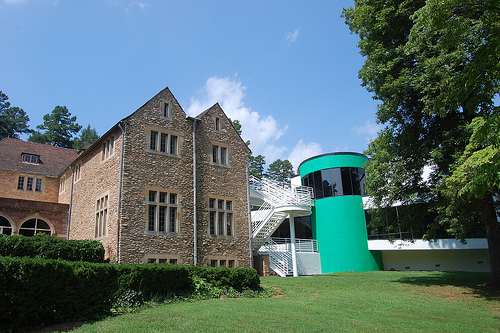 The Southeastern Center for Contemporary Fine art (SECCA), located in Winston-Salem, serves as a nonprofit community resource and revolving exhibit space for American contemporary art. SECCA is defended to encouraging scholarship and research in contemporary art as well every bit supporting the creation of new artworks. It began in 1956 every bit an exhibition space devoted to work by local artists. The center received a new abode when industrialist James G. Hanes willed his 32-acre estate to SECCA in 1972. Renovation of Hanes's mansion, plus construction of a gallery improver and receiving area, was completed in 1976. During this period SECCA initiated an creative person support plan, the National Endowment for the Arts/SECCA Southeastern Artists Fellowships (later known as SECCA/R. J. Reynolds Artists Fellowships). SECCA expanded that program nationally in 1981, initiating the Awards in the Visual Arts (AVA). For ten years, AVA awarded artists fellowships forth with funding museum exhibitions and a purchase program.
In 1990, with a new 24,500-square-pes improver, SECCA shifted its focus to exhibiting the work of major contemporary artists effectually the land while maintaining a commitment to southeastern artists. Completion of the McChesney Scott Dunn Auditorium enabled the center to offering programs in contemporary music, drama, dance, and film every bit well as lectures and conferences on contemporary art bug. In 1994 SECCA initiated the Artist and the Community Project. Structured every bit a series of residencies resulting in the creation of new piece of work, participating artists focus on issues critical to the local community. Working with other customs-based institutions from schools to social service agencies, the program forges a link between artists and community members.
SECCA continues to nowadays the diversity of American contemporary art and encourage creative excellence in the visual arts. A distinctive characteristic of SECCA's galleries is their illumination past natural calorie-free showing through wall-sized glass windows, designed so that no artwork falls prey to the sun's potentially injurious rays. The eye offers 21,000 square feet of showroom space and a 300-seat auditorium.
SECCA at times has come under fire from religious groups and members of Congress, such as retired U.S. senator from North Carolina Jesse Helms. Helms and others, angered by piece of work that they considered blasphemous or pornographic, demanded greater accountability by the National Endowment for the Arts (NEA) and threatened to slash NEA budgets. For example, great outcry arose in 1989 over a twoscore × 40-inch photograph by New York's Andres Serrano, who received $15,000 for his piece of work from the NEA through SECCA. The photograph, titled Piss Christ, shows a wood and plastic crucifix submerged in the artist'south urine. The artist said that his piece of work was "not meant to be an assault on Christ [merely was] questioning organized religion and the commercialization of Christ."
The State of North Carolina formally took over the operations of SECCA on December 13, 2007. SECCA operates as an independent entity as an affiliate of the North Carolina Museum of Fine art, under the N.C. Department of Cultural Resources.
Additional Resource:
Southeastern Center for Contemporary Art official website: http://www.secca.org/ (accessed October 24, 2012).
"Southeastern Center for Gimmicky Fine art, Winston-Salem NC, USA" New Museum Of Gimmicky Fine art. http://www.newmuseum.org/artspaces/view/southeastern-center-for-contemporary-art (accessed October 24, 2012).
Parachini, Allan. "In the Heart of the Tempest : Within the Due north Carolina arts foundation that's under fire for sponsoring a tour of 'offensive' artworks" Los Angeles Times. Baronial 13, 1989. http://articles.latimes.com/1989-08-thirteen/entertainment/ca-799_1_north-carolina-arts (accessed Oct 24, 2012).
"Country to Manage SECCA." (press release). North Carolina Department of Cultural Resources. December 14, 2007. http://news.ncdcr.gov/2007/12/14/state-to-manage-secca/ (accessed October 24, 2012).
"Southeastern Centre for Contemporary Art (SECCA)." http://www.ncdcr.gov/Divisions/Arts/SECCA.aspx (accessed October 24, 2012).
Cohen, Todd. "SECCA aims to reconnect with customs." Philanthropy Journal. July twenty, 2011. http://www.philanthropyjournal.org/north-carolina/nc-top-news/secca-aims-reconnect-with-community
Image Credits:
"SECCA - Winston Salem, North Carolina." Winston-Salem, N.C. August 5, 2010. Flickr user UGArdener. https://www.flickr.com/photos/ugardener/4875179213/
one January 2006 | Kress, Kelly
Source: https://www.ncpedia.org/southeastern-center-contemporary-ar
0 Response to "The Southeastern Center for Contemporary Art Winston Salem January"
Post a Comment